

It’s been an especially tough year for Angelica Lopez.
In the months before the pandemic, her three-year-old daughter Jaelynn had started to do something perplexing—repeatedly rubbing her hand across a spot on the floor in their Throggs Neck apartment and then licking her palm and fingers. Over and over.
Jaelynn is autistic and non-verbal. She couldn’t explain her behavior. But then a blood test provided a clue: Jaelynn had an elevated lead level, most likely from ingesting tiny particles of lead dust shedding from the layers of old paint on the walls in their home—the most common route of lead exposure for children in New York City.
Among the heavy toll COVID-19 has taken on all aspects of daily life, the virus is also upending many of the city’s protocols for preventing childhood lead poisoning, and for catching kids like Jaelynn early in order to prevent further harm, including a decline in testing, home inspections and follow up from health inspectors to conduct abatement work.
The white lead carbonate that was once used in large quantities in lead paint tastes sweet, which may have been why Jaelynn kept coming back for more.
“It’s like an obsession that she has,” said Lopez.
By February, a follow up doctor’s visit showed Jaelynn’s blood-lead levels had risen even further—to double the city’s action level—and according to Lopez, the Department of Health and Mental Hygiene came to her home soon after to take dust samples to determine exactly where the lead was coming from.
“Then everything with the pandemic hit,” said Lopez, who went into lockdown inside an apartment that was likely poisoning her daughter, unsure where the source was. “No one got back to me.”
Lead is a neurotoxin that can cause brain damage, loss of IQ, and behavioral problems in children, even at relatively low levels of exposure. The Centers for Disease Control and Prevention have determined that no level is safe.
In New York City, the number of children with elevated-lead levels has dropped by more than 90 percent over the past 15 years—a fact that’s widely viewed as a public health success story. However, past rates of exposure were so high, that decline still leaves upwards of 3,000 children in the city who are affected each year, the vast majority of whom are children of color.
Mayor Bill de Blasio has pledged to fully “eliminate” lead exposure. But many public -health advocates now warn that—as the pandemic continues to cause disruption—the city may be missing children with high lead levels, especially as many of them are spending more time inside homes with potential lead-paint hazards, and that we may see a spike in the number of lead poisoning cases as a result.
“I think we already have evidence of potential harm,” said Dr. Morri Markowitz, director of the Lead Poisoning and Treatment Program at Montefiore’s Children’s Hospital in the Bronx, which has seen a dramatic decline in the number of children coming in to be screened for lead exposure since the pandemic began.
“Blood testing at Montefiore in our lab went down by between 40 and 50 percent,” said Dr. Markowitz, a trend that’s mirrored by new, citywide data released earlier this week. April saw a decline of 88 percent compared to the same period last year.
More concerning, however, is the impact the coronavirus has had on the Health Department’s ability to send inspectors inside homes to tests for deteriorating lead paint, and to force landlords to make repairs.
Local law requires those inspections to be carried out any time a child tests with a lead level above 5 micrograms. If lead paint violations are found, the health department issues an order to abate. But Dr. Markowitz said that system has struggled to keep pace during the pandemic, and that health officials only prioritized the most extreme cases.
“In our clinic, we were observing that there were delays in getting inspections for kids who had lead levels lower than 45 micrograms,” the level at which Dr. Markowitz said a child is typically hospitalized and treated with chelation therapy to remove large amounts of lead from the bloodstream. “For under 45, they turned off the visits.”
The Health Department did not respond to detailed questions from WNYC/Gothamist about how large the decline in home inspections has been. But a person briefed on the matter said lead inspectors within the department had been reassigned to work on COVID-19 related issues. And while Dr. Markowitz said the city appeared to begin increasing the number of home inspections in mid-September, he expects the Health Department is now faced with a significant backlog of cases like three-year-old Jaelynn in Throggs Neck.
Her mother said a health inspector only returned to their home in late October, eight months after the department’s previous visit, by which time Jaelynn’s lead level had gone up even further.
A Health Department spokesperson did not answer questions about Jaelynn’s case. But the delay in inspections also raises questions over whether landlords are being forced to address dangerous lead-paint conditions, a key pillar of the city’s lead-protection laws.
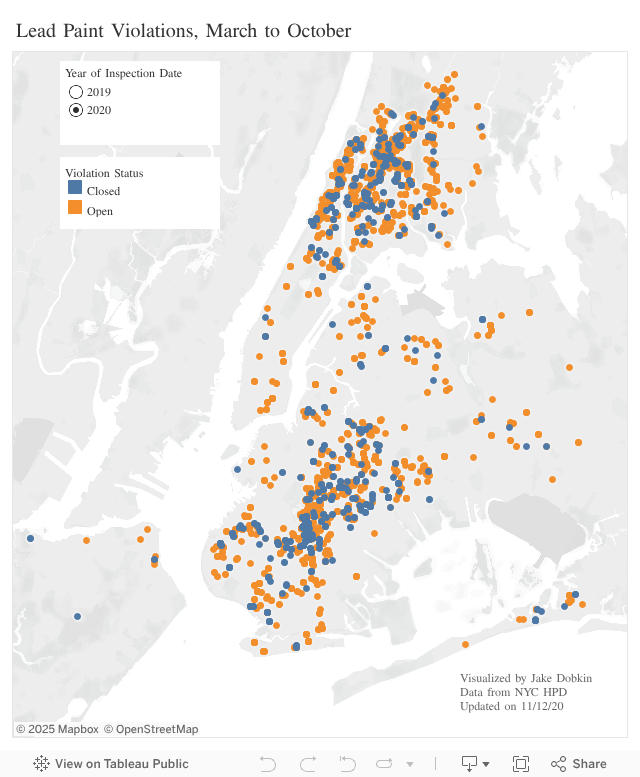
That picture remains unclear—again, the Health Department did not answer a detailed list of questions—and there is no public database of orders that the Health Department issues to landlords to conduct lead-abatement work. But the agency shares responsibility for enforcing those laws with the Department of Housing Preservation and Development, which has seen a nearly 60 percent drop in the number of lead-paint violations issued between late March and the end of October compared to the same period last year, according to an analysis by WNYC/Gothamist.
“The consequences of this from a public health perspective, in terms of the struggle to eliminate lead poisoning in New York City, will definitely take a hit,” said Matthew Chachere, a lawyer who helped write much of the city’s existing lead poisoning prevention laws—known as Local Law 1—in the early 2000s.
HPD also did not answer detailed questions submitted by WNYC/Gothamist, but Chachere said city officials have understandably had to balance the safety of their staff with lead-exposure risks, and many families may not have wanted an inspector entering their home.
“I'm not trying to second guess any of the decisions that were made in the face of a pandemic,” Chachere said. “Those may have been entirely valid decisions. But I do think that we're going to have to think long and hard about what the remedy is going to be going forward.”
In a press release on Tuesday, issued after WNYC/Gothamist submitted questions, the Health Department said its nurses continue to monitor blood-lead testing data in the city, and to call families and doctors when children test above 5 micrograms. It also said it has issued guidance to health care providers to encourage testing, and sent mailings to households with children under the age of three who haven’t been screened.
Nationally, the CDC has warned that nearly half a million children across the U.S. appear to have missed routine blood-lead tests in just the first five months of 2020, although testing in New York City started to rebound since then.
Speaking at a Lead Exposure and Prevention Advisory Committee meeting in October, Kathryn Egan, an epidemiologist with the CDC, said health departments have faced many challenges this year, and that thousands of children have likely experienced delayed access to care and services.
“There have been difficulties in conducting home nursing visits and environmental investigations for children with lead toxicity due to staffing shortages. Health departments have had to develop methods of performing investigations under pandemic conditions,” said Egan, who added that the CDC will work with health departments to ensure that home inspections continue.
But lead prevention costs money, and the city’s $9 billion budget deficit may already be affecting those efforts.
This past summer, an official with the Department of Education told principals it was delaying lead-paint inspections in classrooms due to budget shortfalls, as schools implemented COVID-19 safety measures before students returned in September. That’s after the city spent over $10 million on an initial round of testing and remediation work in school buildings after a WNYC investigation uncovered high levels of lead paint contamination in elementary school classrooms. A DOE spokesperson did not respond to a request for comment.
Public health advocates in the city have urged de Blasio and the City Council to protect funding for lead poisoning prevention programs.
“While New York has made great strides over the years in reducing childhood lead poisoning, this battle is far from won,” read a letter signed by Dr. Markowitz, Chachere, and thirteen others. “We are concerned that the City’s programs pertaining to lead poisoning prevention could be adversely affected by budget modifications or cuts as a result of the COVID-19 pandemic.”
In a written response to WNYC/Gothamist about the letter, Speaker Corey Johnson said the City Council will continue to monitor the situation closely.
"The coronavirus pandemic has uprooted everything this year and has placed incredible burdens on the City's Health Department,” Johnson said. “We must always remain vigilant about the dangers posed to our children by lead poisoning.”
There have been no significant cuts thus far to the Health Department’s and HPD’s budgets for lead-paint inspections, but the city and state’s looming financial shortfall could prompt officials to seek other sources of funding.
WNYC/Gothamist has confirmed that New York Attorney General Letitia James’ office had been investigating the potential of a lawsuit earlier this year against the companies that historically manufactured lead-paint, a fact that was previously unreported.
In 2019, several municipalities in California were awarded over $300 million to cover lead-paint remediation costs in a lawsuit against Sherwin-Williams, ConAgra, and The National Lead Company after a nearly two decade-long legal battle.
A spokesperson for the Attorney General declined to comment on whether the inquiry is ongoing, except to say the office does not confirm or deny it conducted past investigations.
New York City was among the first to attempt to sue lead-paint companies in the 1980s in an effort to recoup at least some of the financial burden placed on taxpayers to deal with the ongoing legacy of lead paint. The lawsuit dragged on for the better part of a decade before it was eventually dropped.
According to de Blasio, the city’s legal department examined the possibility of its own lawsuit last year and determined it would not have a viable case under New York state law.
“I would love to,” de Blasio said, speaking on The Brian Lehrer Show on WNYC in September 2019. “I’m not saying it’s impossible. I’m saying, based on the research we’ve done so far, we don’t think we have a pathway to achieve that.”
Correction: The article has been amended. It originally referred to inspection requirements for the Department of Education as legally-required. Legal requirements do not begin until 2021, however the DOE did commit to changes in its protocols starting in 2019.


